
Nestled amidst the tranquil, forested Nallamala Hills in the Nandyal district of Andhra Pradesh, Srisailam is one of the most revered pilgrimage centres of Sanatana Dharma. Situated near the sacred Krishna River, this ancient kshetra is traditionally known as Sriparvata and is also celebrated as the Kailash of the South. Here, the worship of Lord Shiva and Adishakti comes together in a deeply sacred and ancient tradition.
Introduction
Srisailam is especially significant because Lord Mallikarjuna Swamy, one of the twelve Jyotirlingas, and Maa Bhramaramba, revered in the Ashta Dasha Maha Shaktipeetha tradition, are worshipped within the same sacred temple complex.
For this reason, Srisailam holds profound importance for both Shaiva and Shakta traditions. The living temple tradition worships the divine pair together as Sri Bhramaramba Sameta Mallikarjuna Swamy.
The Story of the Shaktipeeth
According to sacred tradition, when Devi Sati relinquished Her mortal body during the Yajna of Prajapati Daksha, grief-stricken Lord Shiva wandered across the universe carrying Her sacred form.
To restore cosmic balance, Lord Vishnu used His Sudarshana Chakra to divide the mortal body of Mata Sati. The sacred places where Her limbs or ornaments fell later came to be revered as Shaktipeeths.
Sati's Body Part or Ornament
Different Shaktipeeth traditions preserve more than one identification for Srisailam. One prominent tradition associates this sacred region with the fall of Mata Sati's neck or Griva.
Shrishaile Cha Mama Griva Mahalakshmis Tu Devata.
Bhairavah Sambaranando Deshe Deshe Vyavasthitah.
Some other traditions connected with the 51 Shaktipeeths associate Sriparvata with the fall of an anklet or ornament of Mata Sati. These differing descriptions belong to separate textual and regional traditions and are best understood in their respective contexts.
The Name of the Devi
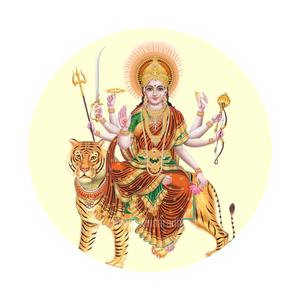
The Divine Mother of Srisailam is worshipped as Maa Bhramaramba, also known as Bhramarambika. She is revered as the presiding Shakti of this sacred mountain kshetra.
Alampure Jogulamba Shrishaile Bhramarambika.
Kolhapure Mahalakshmi Mahurye Ekavirika.
This traditional verse remembers Maa Bhramarambika as one of the celebrated Divine Mothers of the Ashta Dasha Maha Shaktipeetha tradition.
The Story Behind the Name Bhramaramba
The name Bhramaramba is traditionally associated with the Bhramari form of the Divine Mother. The Sanskrit word Bhramara refers to a bee or bee-like creature.
According to Puranic tradition, a powerful Asura named Arunasura obtained a boon that he could not be killed by any two-legged or four-legged creature. Empowered by this boon, he began tormenting the Devas and disturbing the order of the worlds.
The Devas prayed to Adishakti for protection. Bhagavati then manifested in the form of Bhramari Devi and brought forth countless six-legged divine bees. These Bhramaras overwhelmed Arunasura and destroyed his forces.
This Bhramari manifestation is traditionally linked with Maa Bhramaramba of Srisailam. The deeper spiritual message of the story is that Divine Shakti is not limited to any particular form and can manifest even through the smallest forces to defeat overwhelming Adharma.
Bhairava
Some Tantric Shaktipeeth traditions identify the Bhairava of this Peetha as Sambarananda, with variant readings such as Sundarananda appearing in different traditions.
In the living temple tradition of Srisailam, however, Lord Mallikarjuna Swamy is the principal Shiva form worshipped alongside Maa Bhramaramba. The Tantric Bhairava identification and the present temple worship of Mallikarjuna Swamy are therefore best understood within their respective religious contexts.
The Sacred Union of Shiva and Shakti
The defining spiritual identity of Srisailam is the combined worship of Lord Mallikarjuna and Maa Bhramaramba. Devotees receive the blessings of both a Jyotirlinga and a great Shakti shrine within the same sacred temple complex.
This makes Srisailam a powerful symbol of the inseparable unity of Shiva and Shakti. In Shakta philosophy, Shakti represents the active power of the cosmos, while Shiva represents pure consciousness. Their union expresses the completeness of divine reality.
Religious Significance
The glory of Srisailam is praised in several sacred traditions, and the kshetra has long been regarded as one of the great pilgrimage centres of southern Bharat.
Because the Jyotirlinga and Shakti traditions meet here, Srisailam has attracted Shaiva, Shakta, Tantric and devotional practitioners for centuries.
The sacred mountain itself is considered a Tapobhumi, and generations of saints, Yogis and pilgrims have visited Srisailam for Darshan, meditation and spiritual practice.
Puja and Darshan
Daily worship at Srisailam begins in the early morning. Devotees traditionally offer prayers and Abhishekam to Lord Mallikarjuna Swamy and then proceed to receive the Darshan of Maa Bhramaramba.
Worship of the Divine Mother includes traditional offerings such as Kumkum Archana and other Shakta rituals. The Devasthanam also conducts various sacred services including Rudra Homa, Chandi Homa and Mrityunjaya Homa.
Sri Chakra Worship
The worship tradition of Maa Bhramaramba is also associated with Sri Vidya and Sri Chakra practices. In Shakta philosophy, the Sri Chakra represents the Divine Mother through a sacred geometric form embodying multiple levels of cosmic and spiritual reality.
For this reason, Srisailam is revered not only as a destination for ordinary temple Darshan but also as an important centre connected with deeper traditions of Shakti Sadhana.
The Ardhanarishvara Tradition
The spiritual tradition of Srisailam also places great importance on the principle of Ardhanarishvara, the unified form of Shiva and Shakti.
Traditions associated with the wider Srisailam region connect Mata Parvati with penance and the Ardhanarishvari principle, symbolising that Shiva and Shakti are not two separate realities but complementary dimensions of the same Supreme Truth.
Manohara Kund and Other Sacred Places
Older local traditions refer to several sacred Kundas and Tirthas within and around the Srisailam region. Among them, Manohara Kund is remembered as a particularly sacred water source in traditional accounts.
The wider Srisailam pilgrimage also includes important sacred places such as Sakshi Ganapati, Shikhareswaram, Patalaganga, Hatakeswaram and other ancient shrines.
Shikhareswaram, situated on the heights of the sacred mountain, holds special importance in the traditional pilgrimage circuit of Srisailam.
Major Festivals
Maha Shivaratri Brahmotsavam is one of the grandest festivals celebrated at Srisailam. Special processions, rituals and worship are conducted for Lord Mallikarjuna Swamy and Maa Bhramaramba during this sacred period.
Sharadiya Navratri and Chaitra Navratri are also important occasions for the special worship of Maa Bhramaramba.
The sacred month of Kartika, Ugadi and several other major festivals attract large numbers of devotees and are marked by special Deepa offerings and temple rituals.
History
The antiquity of Srisailam extends far into the past, and its earliest origin cannot be assigned with certainty to a single historical period.
Traditional and epigraphic references associate the region with several dynasties, including the Satavahanas, Ikshvakus, Chalukyas, Kakatiyas, Reddy rulers and the Vijayanagara Empire.
During the Reddy period, routes and stone steps were developed to make pilgrimage to Srisailam and Patalaganga more accessible. The Vijayanagara rulers also contributed to the expansion of the temple complex through the construction of Mandapas, gateways and other structures.
Traditions also preserve the memory of a pilgrimage by Chhatrapati Shivaji Maharaj to Srisailam, reflecting the wider importance of the shrine beyond southern India.
Adi Shankaracharya and Srisailam
Srisailam is closely associated in traditional memory with Jagadguru Adi Shankaracharya. It is believed that he performed spiritual practice in this sacred region and worshipped Lord Mallikarjuna and the Divine Mother.
The celebrated Shivananda Lahari is also traditionally connected with his devotion at Srisailam. Such associations are best understood within the devotional and historical traditions surrounding the Acharya.
How to Reach
By Rail: Markapur Road is one of the principal railway options for pilgrims travelling to Srisailam. From the railway station, the onward journey is completed by road.
By Road: Srisailam is connected by road with major cities of Andhra Pradesh and Telangana. Regular buses and private vehicles operate from Hyderabad, Kurnool and other important cities.
By Air: Rajiv Gandhi International Airport, Hyderabad is one of the principal airports used by pilgrims travelling to Srisailam. The remaining journey is completed by road through the Nallamala region.
Darshan Timings
Darshan, Abhishekam and Seva timings at Srisailam may vary according to the day, festival calendar and special temple rituals. Worship begins very early in the morning, and different Darshan and Seva schedules continue throughout the day.
Timings may change during Maha Shivaratri, Navratri, Kartika month and other major religious occasions. Devotees are therefore advised to confirm the current schedule through the official Srisaila Devasthanam information before planning their visit.
Distinctive Traditions and Beliefs
The Nallamala Hills surrounding Srisailam are themselves regarded as a sacred Tapobhumi. Devotees traditionally believe that entering this holy region and beholding the sacred mountain brings a sense of inner stillness, devotion and detachment.
A well-known local belief associated with Maa Bhramaramba also speaks of a subtle humming sound resembling bees near the sacred area of the Goddess. Devotees connect this belief with the Bhramari form of the Divine Mother. It is best understood as part of the living devotional tradition of the shrine.
Spiritual Message
The story of Maa Bhramaramba and Arunasura teaches that Divine Shakti can manifest in any form necessary to protect Dharma. Even what appears small or insignificant can become a powerful instrument of divine protection when moved by the grace of Bhagavati.
The combined worship of Lord Mallikarjuna and Maa Bhramaramba reveals the inseparable unity of Shiva and Shakti. Consciousness and energy, wisdom and action, renunciation and compassion must remain in balance for spiritual life to become complete.