


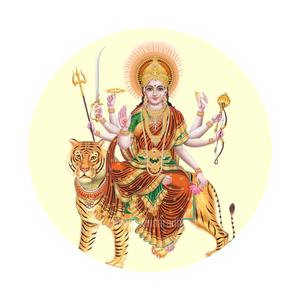
At the southernmost tip of India, where the Indian Ocean, the Arabian Sea, and the Bay of Bengal converge in a sacred confluence, rests the revered Shri Kanyakumari Shaktipeeth. According to the venerable Shakta texts Tantrachudamani and Peethanirnaya, this holy pilgrimage marks the sacred spot where the back portion (Prishthabhaga) of Mata Sati fell. Here, Bhagavati is worshipped as Sharvani, and Her guardian Bhairava is venerated as Nimisha. In the regional tradition, this sacred abode is celebrated as the Arulmigu Bhagavathy Amman Temple, where the Devi presides as an ascetic maiden holding an Akshamala.
Introduction
Kanyakumari Dhama is an ancient and sacred pilgrimage situated at the southern boundary of India. Here lies the extraordinary confluence of three great oceans, revered as the Triveni Sangam. Within the sanctum sanctorum of the temple, the divine idol of Ma Bhagavathy is consecrated in dark stone. In Her hands, She holds a rosary of beads, embodying Her ceaseless tapasya and unbroken vow of maidenhood. The atmosphere of the shrine remains peaceful and deeply devotional, with the ocean waves perpetually lapping at the sacred feet of Bhagavati.
The story of the Shaktipeeth
According to sacred tradition, when Devi Sati relinquished Her life in the sacrificial fire of Daksha Prajapati's yajna, a grief-stricken Lord Shiva wandered the universe carrying Her sacred form. To restore balance to creation, Lord Vishnu used the Sudarshana Chakra to divide Devi's mortal remains. Wherever parts of Her body and sacred ornaments fell across the earth, those sacred spaces arose as consecrated Shaktipeeths. In this sacred realm of Kanyashrama, the back of Mata Sati descended, consecrating this holy ground as a supreme center of Shakti sadhana.
Sati’s body part or ornament
In accordance with the foundational Shakta authority Tantrachudamani, the back portion (Prishtha) of Mata Sati fell at the Kanyashrama Shaktipeeth. In spiritual contemplation, this peetha represents inner strength and the awakening of spinal energy in a devoted sadhaka.
The name of the Devi
The presiding Devi of this Shaktipeeth is worshipped as Sharvani, the eternal consort and divine energy of Lord Shiva in His form as Sharva. Locally, She is lovingly adored as Kumari Amman and Bhagavathy Amman.
Bhairava
The guardian Bhairava of the Kanyashrama Shaktipeeth is venerated as Nimisha, who abides in subtle presence to protect the sacred abode of the Devi and guide sincere seekers.
Religious significance
The spiritual sanctity of Kanyakumari has been revered across the ages. In the Vana Parva (Chapter 85) of the Mahabharata, Maharshi Pulastya extols the glory of Kanyatirtha:
Tatastire samudrasya kanyatirthamupasprishet |
Tatropasprishya rajendra sarvapapaih pramuchyate ||
This verse proclaims that by touching and bathing in the sacred waters of Kanyatirtha on the ocean shore, one attains purification from all past impurities. Following a holy dip at the confluence, pilgrims offer prayers at Matritirtha, Pitritirtha, and Bhimatirtha. Near the seashore lies a natural freshwater spring known as Manduka Tirtha. Devotees traditionally offer prayers first at the seaside shrine of Lord Ganesha before presenting themselves before Bhagavati Amman.
Puja and darshan
The daily rituals at the temple are observed with great devotion in accordance with traditional Vedic and Agama guidelines. Every morning begins with the sacred abhishekam of the Devi, followed by shodashopachara puja throughout the day. Pilgrims are expected to observe purity and modesty within the sacred grounds. When stepping into the inner courtyard, men are traditionally required to remove their upper clothing and wear a dhoti or veshti. Women are welcomed in traditional sarees or modest attire.
Major festivals
Sharad Navratri and Vasant Navratri are celebrated here with immense reverence and festive devotion. Additionally, the ten-day Brahmotsavam in the month of Vaisakha (May–June), as well as sacred observances during the Tamil months of Aadi and Margazhi, draw large numbers of devotees. On these sacred occasions, joyous rathotsavams and ornate palanquin processions of the Devi are held.
History
The temple at Kanyakumari carries an unbroken spiritual legacy spanning centuries. Throughout different eras, the Pandya, Chola, Nayaka, and Travancore royal dynasties patronized the shrine, adding grand mandapams, prakarams, and gopurams. Architecturally, the complex presents a harmonious blend of Dravidian and Kerala temple designs. A short distance across the waters lies the holy rock where Swami Vivekananda engaged in deep meditation in 1892, now honored as the Vivekananda Rock Memorial.
How to reach
By Rail: Kanyakumari Railway Station is well connected with major cities across the nation, including Chennai, Delhi, Mumbai, and Bengaluru.
By Road: The pilgrimage center is linked via national highways. Frequent state transport and private buses operate from Nagercoil, Thiruvananthapuram, and Madurai.
By Air: The nearest airport is Thiruvananthapuram (Trivandrum) International Airport, located approximately 90 kilometers away.
Darshan timings
In accordance with official temple administration schedules, the shrine opens daily for darshan in two sessions:
Morning Session: 04:30 AM to 12:30 PM
Evening Session: 04:00 PM to 08:30 PM
Distinctive traditions
According to sacred tradition, the demon Banasura held a boon that he could only be vanquished by an unmarried maiden. Manifesting as an ascetic virgin, Bhagavati vanquished Banasura and restored peace to the cosmos. Remaining permanently on this coastal cape with an Akshamala in hand, Devi chose perpetual tapasya and maidenhood, turning this sacred sanctuary into an eternal symbol of self-restraint, purity, and spiritual devotion.
Spiritual message
Shri Kanyakumari Shaktipeeth calls the seeker away from worldly distractions toward inward dedication and single-pointed devotion. Situated at the holy confluence of three vast oceans, it signifies that when all diverse thoughts and aspirations surrender at the feet of Bhagavati, the seeker attains unshakable tranquility and spiritual realization.