


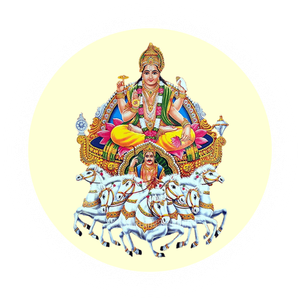
In Sanatana Dharma, Lord Surya Dev is venerated as the Pratyaksha Devata—the directly visible deity. In the manifest universe, He is regarded as the supreme source of light, vital energy, consciousness, and sustenance. The Rigveda reveres Surya as the cosmic soul of both the animate and the inanimate. Rising faithfully each morning, Bhagavan Bhaskara dispels darkness, inspiring living beings toward righteous conduct, duty, and spiritual awareness.
Introduction
According to Puranic tradition, Lord Surya is the radiant son of Sage Kashyapa and Mata Aditi, which is why He is known as Aditya. In Vedic literature, He is also revered as Vivasvan. Sangya and Chhaya are traditionally honored as His consorts.
Among His divine progeny are Vaivasvata Manu, Dharmaraja Yama, the sacred river Yamuna, Shani Dev, and the divine healers, the Ashvini Kumaras. The illustrious lineage of Lord Rama, the Suryavansha, traces its revered origins to Lord Surya through Vaivasvata Manu and King Ikshvaku.
Form and tradition
In classical iconography and dhyana traditions, Lord Surya is depicted with an intensely luminous, golden aura. He holds blooming lotuses in both hands, symbolizing detachment, spiritual awakening, and supreme knowledge. His celestial chariot moves upon a single great wheel, representing the eternal and unceasing cycle of cosmic time (Kalachakra).
Japākusumasaṅkāśaṁ kāśyapeyaṁ mahādyutim .
Tamo’riṁ sarvapāpaghnaṁ praṇato’smi divākaram .
Lord Surya’s chariot is drawn by seven noble horses, symbolically representing the seven days of the week, the seven colors of visible light, and the seven classical Vedic meters: Gayatri, Ushnik, Anushtup, Brihati, Pankti, Trishtup, and Jagati. Aruna, the son of Sage Kashyapa and Vinata, serves as the divine charioteer, heralded each dawn by the gentle crimson glow of morning light.
Traditional worship attributes twelve sacred names to Lord Surya: Mitra, Ravi, Surya, Bhanu, Khaga, Pushan, Hiranyagarbha, Marichi, Aditya, Savitr, Arka, and Bhaskara. These divine names celebrate His universal roles as creator, sustainer, illuminator, and nurturer of all creation.
Astrological influence
In classical Vedic astrology (Parashari Hora Shastra), Surya is revered as the king of the Navagrahas. Traditionally, Surya serves as the natural Atmakaraka (significator of the soul), Pitrikaraka (significator of the father), and the symbol of vitality, inner will, leadership, and public honor.
Surya governs the zodiac sign of Simha (Leo). Mesha (Aries) is His sign of exaltation, reaching deep exaltation at 10 degrees, while Tula (Libra) is considered His sign of debilitation, reaching deep debilitation at 10 degrees. The first 20 degrees of Simha constitute His Moolatrikona placement. In the Parashari system, Surya casts a full seventh-house aspect from His natal position.
Surya rules the nakshatras of Krittika, Uttara Phalguni, and Uttara Ashadha. Under the Vimshottari Dasha system, Surya’s Mahadasha lasts for 6 years. Traditional Jyotisha considers this an interpretive and symbolic framework rather than fatalistic causation; any planetary placement must always be evaluated in the context of the entire horoscope, including house strength, aspects, and planetary transits.
Religious significance
Scriptures describe the veneration of Surya as a sacred path to inner purification, mental clarity, and gratitude toward nature. The celebrated Gayatri Mantra from the Rigveda invokes the divine radiance of Savitr to inspire and illuminate human intellect toward righteousness.
In the Yuddha Kanda of the Valmiki Ramayana, the revered sage Agastya imparted the Aditya Hridaya Stotra to Lord Rama on the battlefield. Reciting and reflecting upon this sacred hymn is traditionally cherished as a devotional means to cultivate courage, perseverance, and unwavering dedication to Dharma.
Puja and worship
Daily worship of Lord Surya is simple, serene, and deeply rooted in gratitude. After morning ablutions, devotees traditionally face east during sunrise and offer Arghya (a ceremonial water offering) from a clean copper vessel containing water, kumkum, akshata (unbroken rice), and fresh flowers. Reverence is practiced by looking through the gentle falling stream of water toward the horizon. For eye safety, looking directly into the intense midday sun without protection is strictly avoided.
India is home to several historic temples dedicated to Lord Surya. The Arasavalli Sri Suryanarayana Swamy Temple in Srikakulam, Andhra Pradesh, and the west-facing Deo Sun Temple in Aurangabad, Bihar, are living centers of active worship. In addition, the Konark Sun Temple in Odisha, the Modhera Sun Temple in Gujarat, and the Martand Sun Temple in Kashmir stand as magnificent protected architectural monuments celebrating this ancient tradition.
Major festivals
Several sacred festivals throughout the year honor the grace of Lord Surya:
1. Makar Sankranti: Celebrating the transition of the Sun into the zodiac sign of Makara (Capricorn), marking the start of Uttarayana. Devotees honor this day with sacred river baths, Surya Arghya, and charitable offerings.
2. Ratha Saptami: Observed on the seventh day of the bright half of Magha, this day is celebrated as Surya Jayanti, symbolizing the symbolic emergence of the sun chariot and reaffirming health, vitality, and devotion.
3. Chhath Puja: Celebrated primarily in the months of Kartika and Chaitra, this revered multi-day festival represents selfless gratitude to nature and the Sun deity, featuring sacred offerings at both sunset and sunrise.
Spiritual message
The timeless message of Lord Surya Dev is one of discipline, universal benevolence, and selfless service (Nishkama Karma). Just as the sun bestows warmth, illumination, and life equally upon all beings without bias or expectation, seekers are encouraged to cultivate equanimity, let go of ego, and dedicate their daily actions to the welfare of all.
True devotion to Lord Surya is realized through daily discipline, heartfelt respect for parents and elders, and walking steadfastly upon the path of truth.