


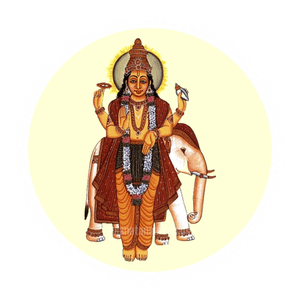
In Sanatana Dharma, Devguru Brihaspati is revered as one of the presiding deities of the Navagraha Mandala and is regarded as the embodiment of purity, wisdom, and Dharma. As the revered Guru of the Devas, he represents knowledge, discernment, righteous conduct, and spiritual awareness. According to Hindu tradition, his divine blessings inspire devotees to develop sound judgment, seek the guidance of enlightened teachers, and lead a life rooted in Dharma.
In Vedic astrology, Brihaspati, also known as Guru or Jupiter, is regarded as one of the principal naturally benefic planets. He signifies education, Dharma, children, prosperity, higher learning, and spiritual wisdom. According to traditional Jyotisha, a favourably placed Jupiter in the birth chart is associated with wisdom, prosperity, integrity, and a strong sense of justice.
Introduction
Devguru Brihaspati is the son of Maharishi Angiras and the revered spiritual preceptor and priest of the Devas. In the Puranic narratives, he guides Indra and the other celestial deities in matters of Dharma, righteous conduct, sacred rituals, and duty. He is also known by names such as Devacharya, Angirasa, Jiva, and Vachaspati.
Brihaspati is not merely the teacher of the Devas; he also represents the sacred Guru Tattva, the principle of divine guidance that dispels ignorance and leads the individual towards truth, wisdom, and Self-realisation. His worship teaches us to unite knowledge with humility, Dharma with compassion, and strength with righteous conduct.
Vedic and Puranic Significance
The Rigveda contains hymns dedicated to Brihaspati and Brahmanaspati. In the Vedic tradition, these divine names are associated with sacred speech, prayer, the power of Mantras, and Yajna. In the later Puranic tradition, Brihaspati became especially revered as the spiritual preceptor of the Devas.
Puranic narratives frequently mention Devguru Brihaspati and Daityaguru Shukracharya. While Brihaspati guides the Devas on the path of Dharma and righteous conduct, Shukracharya is regarded as the Guru of the Asuras. The teachings associated with Brihaspati remind us that the true purpose of knowledge is not merely to acquire power, but to use wisdom for the preservation of Dharma and the welfare of all beings.
Divine Form and Traditional Depiction
In Puranic descriptions and traditional iconography, Lord Brihaspati is depicted with a radiant golden complexion, adorned in yellow garments. His divine form is characterised by a peaceful expression and a luminous aura. In some traditions, he is represented with four arms, holding a staff, Rudraksha beads, and a Kamandalu (water vessel), while one hand is raised in Varada Mudra, the gesture of blessing.
The Navagraha Stotra, traditionally attributed to Maharishi Vedavyasa, offers the following prayer to Devguru Brihaspati:
Devanam Cha Rishinam Cha Gurum Kanchana Sannibham ।
Buddhibhutam Trilokesham Tam Namami Brihaspatim ॥
Meaning: I bow to Brihaspati, the revered Guru of the Devas and Rishis, who shines with the brilliance of gold and embodies divine wisdom.
The Rigveda also contains a sacred hymn praising Brihaspati:
Brihaspate Ati Yadaryo Arhad Dyumad Vibhati Kratumaj Janeshu ।
Yad Didayach Chavasa Ritaprajata Tad Asmasu Dravinam Dhehi Chitram ॥
Meaning: O Brihaspati! Your divine radiance and power shine through the noble actions of humanity. Bless us with auspicious prosperity and the means to lead a righteous and fulfilling life.
Significance of Brihaspati in Vedic Astrology
In Vedic astrology, Brihaspati is known as Guru, the planet Jupiter. He is regarded as a primary significator of Dharma, wisdom, sound judgment, children, wealth, Vedic knowledge, higher education, and spiritual progress. In traditional Jyotisha, a favourably placed Jupiter is associated with generosity, integrity, good judgment, reputation, and righteous conduct.
Brihaspati rules Sagittarius (Dhanu) and Pisces (Meena). Cancer (Karka) is his sign of exaltation, while Capricorn (Makara) is his sign of debilitation. Jupiter attains his exact exaltation point at 5 degrees of Cancer and his exact debilitation point at 5 degrees of Capricorn. According to the commonly followed Parashari tradition, the first 10 degrees of Sagittarius form Jupiter's Moolatrikona region.
Special Aspects of Jupiter
According to Parashari Jyotisha, Jupiter has special aspects on the fifth, seventh, and ninth houses from his position. The fifth aspect is traditionally associated with knowledge, intelligence, and children; the seventh with relationships and cooperation; and the ninth with Dharma, fortune, and higher wisdom. The interpretation of these aspects depends on the houses involved and the overall planetary configuration of the birth chart.
Jupiter's Nakshatras, Dasha, and Transit
Brihaspati is the planetary ruler of three Nakshatras: Punarvasu, Vishakha, and Purva Bhadrapada. In the Vimshottari Dasha system, Jupiter's Mahadasha lasts for 16 years. In Vedic astrology, Jupiter's movement from one zodiac sign to another is known as Guru Gochar, or Jupiter transit. Its traditional significance is considered in matters such as Dharma, education, marriage, children, and other important areas of life.
A strong Jupiter in the birth chart is generally regarded as auspicious. However, definite results cannot be predicted solely from Jupiter's exaltation, placement in his own sign, or Mahadasha. His house lordship, aspects, conjunctions, planetary periods, and other chart conditions must also be considered.
Religious Significance
In Sanatana Dharma, Devguru Brihaspati is honoured as a guardian of knowledge, Dharma, and righteous conduct. Jupiter's position is traditionally considered during the selection of auspicious Muhurtas for important Samskaras, including marriage, Vidyarambha (initiation into education), Yajnopavita (sacred thread ceremony), and Diksha (spiritual initiation). However, an auspicious Muhurta is determined through several Panchang elements, including Tithi and Nakshatra, rather than Jupiter's position alone.
The deeper spiritual significance of Brihaspati worship lies in cultivating truthfulness, compassion, respect for teachers, and devotion to Dharma. In the Hindu tradition, the Guru is honoured as the spiritual guide who removes ignorance. Serving and respecting one's parents, teachers, and spiritual preceptors is therefore regarded as an important expression of Guru Bhakti.
Puja and Worship of Devguru Brihaspati
Thursday, known as Guruvar or Brihaspativar, is considered especially auspicious for the worship of Devguru Brihaspati. Devotees traditionally begin the day with a bath, wear clean yellow garments, and offer prayers to Lord Brihaspati or Lord Shri Hari Vishnu. Yellow flowers, turmeric, and Sattvic offerings are commonly used during worship.
Guru Hora and the Nakshatras Punarvasu, Vishakha, and Purva Bhadrapada are also considered favourable for Mantra Japa in traditional astrology. In specific Graha Shanti rituals, 19,000 repetitions of the Brihaspati Beej Mantra are traditionally prescribed. Such elaborate rituals are best performed under the guidance of a qualified Acharya.
Brihaspati Beej Mantra
Om Gram Greem Graum Sah Gurave Namah ॥
Brihaspati Nama Mantra
Om Brim Brihaspataye Namah ॥
In addition, certain Tantric and devotional traditions use the following Mantras in the worship of Brihaspati:
Om Aim Kleem Brihaspataye Namah ।
Om Shreem Gurave Namah ॥
Sattvic Remedies and Charitable Offerings
According to religious and astrological traditions, donating yellow clothes, Chana Dal (split chickpeas), turmeric, jaggery, saffron, yellow flowers, and sacred scriptures on Thursdays is considered auspicious. Such offerings may be made to a deserving Acharya, student, or person in need, according to one's means and devotion.
Respecting parents and teachers, supporting students in their education, practising Gau Seva (service to cows), and worshipping Lord Vishnu are also regarded as meaningful Sattvic practices associated with Guru Tattva. In some regional traditions, lighting a lamp near a banana tree is also customary. Appropriate fire safety and care for the environment should always be maintained.
In traditional Jyotisha, wearing a yellow sapphire (Pukhraj) is sometimes recommended as a remedy associated with Jupiter. However, this gemstone is not considered suitable for everyone. Such a recommendation should not be made solely on the basis of one's zodiac sign without examining the overall birth chart.
Major Festivals and Auspicious Occasions
Every Thursday (Brihaspativar) is regarded as a special day for the regular worship of Devguru Brihaspati. Guru Purnima, celebrated on the full moon day of the Ashadha month, is another sacred occasion dedicated to expressing gratitude and reverence towards the Guru Tattva. This festival honours spiritual teachers and the Guru tradition as a whole, rather than being limited to the worship of Jupiter.
Special worship, Mantra Japa, and Navagraha Shanti rituals are also observed in certain traditions during Guru Gochar (Jupiter's transit between zodiac signs), significant Nakshatra combinations, and other auspicious astrological occasions.
Spiritual Message
The divine character of Devguru Brihaspati teaches us that true prosperity does not lie merely in the accumulation of wealth, position, or recognition, but in the cultivation of wisdom, righteous conduct, self-discipline, and Dharma. A person who honours their teachers, follows the path of truth, and uses knowledge for the welfare of others brings the sacred Guru Tattva into their life.
The essence of Brihaspati worship is to keep our thoughts pure, our speech disciplined, our actions aligned with Dharma, and our hearts filled with unwavering devotion to the Divine.