


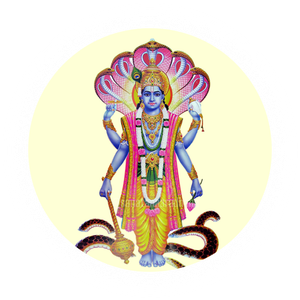
O revered devotees, immerse yourselves in this sacred narrative from the Puranas, which beautifully illustrates the profound glory and immense blessings bestowed by observing Amalaki Ekadashi. This ancient tale reveals how even unintentional devotion can lead to the highest spiritual merits and divine protection.
The Sacred Tale of the Hunter and Prince Vasurath
Suta ji addressed the eighty-eight thousand Rishis and said, “O revered sages! This ancient narrative is profoundly significant. Once, the great Emperor Mandhata humbly requested his revered family guru, Maharshi Vashishtha, ‘O Gurudev! Please reveal to me a Vrat that embodies the essence of all Vrats, one that uproots sins completely and ultimately leads one to the divine abode of Bhagwan.’ ”
Maharshi Vashishtha, with great delight, responded, “O King! The Ekadashi that falls in the bright fortnight (Shukla Paksha) of the month of Phalguna is known as ‘Amalaki Ekadashi.’ This Vrat is exceedingly dear to the devotees of Bhagwan Vishnu. Its merit is said to be equivalent to donating a thousand cows. And on this day, the Amalaki (Indian gooseberry) tree, when worshipped, is no longer merely a fruit; it is revered as an embodiment of Bhagwan Vishnu Himself, for the ancient Puranas state that it originated directly from the divine mouth of Shri Hari.”
The Sacred Origin of the Vrat
Vashishtha ji continued, “This tale speaks of a city named Vaidik. It was a city of virtuous souls, where Brahmins remained engrossed in their Vedic recitations, Kshatriyas diligently protected Dharma, Vaishyas were generous in charity, and Shudras devoted themselves to service, never transgressing the sacred rules. In that city, there was no trace of theft, deceit, atheism, or animosity towards the Divine.
In that very city, a king of the Chandravanshi (Lunar) dynasty, named Chaitrarath, reigned. He was wise in statecraft, benevolent, and a devout follower of Vaishnava Dharma. A strict custom prevailed in his kingdom: whatever Ekadashi arrived, everyone, from the king himself down to the youngest child, would observe the Vrat. No excuses were tolerated.”
The Auspicious Amalaki Ekadashi
Then came the Amalaki Ekadashi of Phalguna Shukla. On that day, the King himself led the observance. The townspeople, ministers, soldiers, women, and elders—all together entered the temple. At a pure and clean spot, a Kalash was established, and the Dhatri (Amalaki) tree was worshipped with incense (dhup), lamps (deep), sacred offerings (naivedya), five jewels (pancharatna), and an umbrella (chhatra). All prayed in unison—
“O Dhatri Devi! You have manifested from the very essence of Brahman; you are the remover of sins, worshipped by Prabhu Shri Ram Himself—please accept us and cleanse us of our imperfections.”
Throughout the night, chanting of Hari’s divine names (Harinaam), sacred stories (Katha), narrations of Ekadashi’s glory (Ekadashi-Mahatmya), and devotional singing (Kirtan) continued.
The Hunter’s Unintended Blessing
That very night, a hunter, wandering aimlessly, eventually arrived at the temple. By nature, he was violent, sustaining his family by killing creatures; he did not possess the conduct of a saintly person. But that day, he was utterly exhausted by hunger and thirst. He thought, “Let me just sit here.”
He sat down in a corner. The Harikatha (stories of Bhagwan Hari), the glories of Ekadashi (Ekadashi-Mahatmya) being sung, and the bhajans (devotional songs) being chanted—all fell upon his ears. He neither took the Sankalp for the Vrat nor understood its rituals—he simply remained awake. In the morning, when everyone returned to their homes, he too went back and ate his meal in his usual manner.
But behold the divine arrangement of Bhagwan—unknowingly, he had observed the Ekadashi Jagaran (staying awake through the night) and had also listened to the sacred Katha of Shri Hari.
His Next Birth: King Vasurath
Some time later, that hunter passed away. His life had been filled with much violence, so ordinarily, he would have attained a lower state of existence. But due to the merit (Punya) accumulated from staying awake that one night and being present in the Amalaki Puja assembly, he was born into the household of the Chandravanshi King Vidurath. His name became Vasurath.
Growing up, this Vasurath became an extremely radiant, powerful, generous, and righteous king, devoted to Dharma. He possessed a Chaturangini Sena (four-fold army), ten thousand villages were under his dominion, his face radiated coolness like the moon, and in valor, he appeared like Bhagwan Vishnu Himself. All this was the fruit of his Ekadashi Jagaran in his previous birth.
A Perilous Encounter in the Forest
One day, King Vasurath set out for a hunt. The forest was vast, and he lost his way. As afternoon approached, he rested beneath a tree and fell asleep. Just then, a band of mountain dacoits arrived.
The dacoits recognized the King and exclaimed, “This is that very king! He once devastated our clan and punished our people—today, we shall have our revenge!”
They all fell upon the King. Whatever weapons they possessed—spears, swords, tridents—they all aimed at the King’s body.
But to their astonishment! As soon as those weapons touched the King, they shattered like flowers. Arrows that should have struck him seemed to halt in mid-air. The dacoits were bewildered! They attacked again and again, but the King remained unharmed.
The Divine Manifestation of Devi Maa
At that very moment, a divine woman manifested from the king’s body. She was radiant and adorned with ornaments, yet her brows were fierce, and flames seemed to blaze from her eyes.
In a single moment, that Devi turned all the weapons of the robbers back upon them. The very weapons they had aimed at the king began to fall upon them instead. Within moments, all the robbers lay defeated on the ground.
When the king awoke, he saw dead bodies lying all around him. Astonished, he began to wonder, “I was alone here. Who has done all this? Who is my protector in this forest?”
At that moment, a divine voice came from the sky: “O King! Bhagwan Vishnu Himself has protected you. You had forgotten Him, but He did not forget you. All this is the effect of the sacred merit earned through Amalaki Ekadashi.”
The king immediately bowed to Bhagwan and returned to his city.
Fruit of the Vrat
Vashishtha Ji said, “O Mandhata! Understand this clearly — that hunter knew neither the Sankalp, nor the mantras, nor the proper Vidhi. Yet, simply by being present in the company of Hari Katha and keeping vigil on the day of Amalaki Ekadashi, he received such great merit that he became a king in his next birth. And in a time of danger, the divine power of Bhagwan Himself manifested from his own body and protected him.
Therefore, if a person knowingly observes this Vrat with proper Vidhi, worships the Amla tree, and remembers Bhagwan Vishnu, then not only are their sins removed from the root, but even the hidden dangers on their karmic path begin to turn away on their own.”
Summary of the Katha
- Amalaki Ekadashi, observed on Phalgun Shukla Ekadashi, is considered one of the most gentle yet powerful Ekadashis in the Vaishnav tradition.
- Here, Amla is not seen merely as a medicinal fruit, but as a sacred, Vishnu-born, sin-removing, and welfare-giving divine power.
- Even unknowingly, if someone sits in the company of Hari Katha, keeps vigil, or participates in divine worship on this Tithi, they receive its spiritual benefit. This Katha stands as proof of that truth.
- The unseen protection one receives in times of crisis is often the result of such accumulated good karma and sacred actions.
- That is why this Ekadashi is described as superior among Vrats and ultimately capable of granting Vaikunth.