


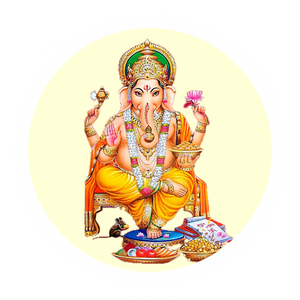
Shri Ganesh Chaturthi, also known as Vinayaka Chaturthi and Ganeshotsav, is one of the major Hindu festivals dedicated to Bhagwan Shri Ganesh. It is celebrated with great Shraddha and devotion on the Chaturthi Tithi of the Shukla Paksha in the month of Bhadrapada. Bhagwan Ganesh is worshipped as the giver of wisdom, discernment, auspiciousness and prosperity, and as Vighnaharta—the remover of obstacles. For this reason, it is customary to remember and worship Bhagwan Ganesh before beginning any auspicious work, Puja or religious ceremony.
On Ganesh Chaturthi, devotees install a Murti of Bhagwan Ganesh in their homes and at public celebrations and worship Him according to traditional rituals. Ganeshotsav is celebrated with particular grandeur in Maharashtra and many other parts of India. Depending on family and regional traditions, devotees may worship the Murti of Bhagwan Ganesh for one day, one and a half days, three days, five days, seven days or until Anant Chaturdashi. The celebration concludes with the respectful Ganesh Visarjan.
Religious Significance of Ganesh Chaturthi
Bhagwan Ganesh is worshipped as Vighnaharta, Mangalkarta, the giver of wisdom and the Lord of the Ganas. The Shiv Purana describes how Bhagwan Ganesh received the boon of being worshipped before all other Devas. This is why Shri Ganesh is traditionally worshipped first during weddings, Griha Pravesh, Yagya, religious ceremonies and before beginning any new or auspicious work.
Ganesh Chaturthi is not merely an occasion to worship Bhagwan Ganesh. His sacred Katha also teaches us the importance of duty, devotion to one’s parents, courage and wisdom. Bhagwan Ganesh remained steadfast in carrying out the responsibility entrusted to Him by Mata Parvati, even when faced with extraordinary circumstances. His unwavering commitment to His duty is one of the reasons He is also revered as an embodiment of determination and Dharma.
The Complete Katha of Shri Ganesh Chaturthi — According to the Shiv Purana
The Kumar Khanda of the Rudra Samhita in the Shiv Purana contains a detailed account of the appearance of Bhagwan Ganesh. According to this sacred Katha, Mata Parvati desired a devoted attendant who would follow Her instructions alone. It is from this divine episode that the Lila of the appearance of Bhagwan Ganesh begins.
Mata Parvati Creates the Divine Child
Once, on Mount Kailash, Mata Parvati was with Her companions. Her Sakhis, Jaya and Vijaya, observed that all the Ganas of Bhagwan Shiv primarily followed His commands. They therefore suggested that Mata Parvati should also have someone devoted specifically to carrying out Her instructions.
Some time later, as Mata Parvati prepared to bathe, She created a beautiful and powerful child from the Ubtan and substances from Her own body. Mata Parvati gave life to the child, adorned Him with beautiful clothes and ornaments, and lovingly accepted Him as Her own son.
Mata Parvati said to the child— “You are My son. From today, you shall guard My doorway. Do not allow anyone to enter without My permission.”
The child obediently accepted Mata Parvati’s command. She gave Him a staff and then went inside to bathe. The child stood faithfully at the entrance and began carrying out the duty entrusted to Him by His Mother.
Bhagwan Shiv and the Child Meet at the Entrance
After some time, Bhagwan Shiv arrived and proceeded towards the chamber of Mata Parvati. The child did not recognise Bhagwan Shiv and stopped Him at the entrance, explaining that Mata Parvati was bathing and that no one was permitted to enter without Her permission.
Bhagwan Shiv explained that He was the husband of Mata Parvati and that this was His own abode. However, for the child, the command of His Mother was supreme. He therefore refused to allow even Bhagwan Shiv to enter.
Bhagwan Shiv then instructed His Ganas to move the child away from the entrance. Nandi and the other Shivaganas approached the child and tried to reason with Him, but He refused to abandon the duty given to Him by Mata Parvati. Eventually, a battle began between the child and the Shivaganas.
The Battle Between Bhagwan Shiv and the Child
The son of Mata Parvati possessed extraordinary strength and courage. Standing alone, He confronted many of the Ganas of Bhagwan Shiv and defeated them. Everyone was astonished by the remarkable valour of the young child.
When Mata Parvati learned of the battle, She manifested Her divine Shaktis to support Her son. Empowered by Mata Parvati’s Shakti, the child became even more formidable. The Devas also attempted to stop Him, but He remained steadfast at His post.
Eventually, Bhagwan Vishnu also became involved in the battle. The child courageously confronted Bhagwan Vishnu and the other Devas. His extraordinary strength and bravery were such that even Bhagwan Vishnu acknowledged His remarkable valour.
The Severing of the Child’s Head
The battle continued for a long time. A fierce confrontation also took place between Bhagwan Vishnu and the child. During the conflict, Bhagwan Shiv found an opportunity to advance and severed the child’s head from His body with His Trishul.
As soon as the child fell, the battle came to an end. However, this event led to an even more serious situation. When Mata Parvati learned that Her son had been killed, Her profound grief transformed into intense divine wrath.
The Wrath of Mata Parvati
Upon hearing of Her son’s death, Mata Parvati was overwhelmed with grief and anger. She declared that if Her son was not restored to life, She would bring about the destruction of the entire creation.
In Her fierce form, Mata Parvati manifested numerous divine Shaktis. These powerful manifestations began moving towards the Devas, Ganas and other beings. Witnessing the terrifying form of Mata Parvati, the Devas became deeply concerned.
The Devas and Rishis offered prayers to Mata Parvati and pleaded with Her to calm Her anger. Mata Parvati then clearly stated Her conditions: Her son must be restored to life and must also be granted an honoured and supreme position among the Devas. Only then would Her anger subside.
The Child Is Revived with the Head of an Elephant
Hearing the words of Mata Parvati, Bhagwan Shiv decided to restore Her son to life. He instructed the Devas and His attendants to travel towards the north and bring back the head of the first living being they encountered.
Following the command of Bhagwan Shiv, the Devas travelled north. The first creature they encountered was a one-tusked elephant. They brought its head back and placed it upon the body of Mata Parvati’s son.
The Devas then sprinkled sacred water, sanctified with Mantras, upon the child’s body. By the divine will of Bhagwan Shiv, the child regained consciousness and sat up as naturally as one awakening from a deep sleep. He now had the majestic face of an elephant and radiated extraordinary divine brilliance.
Seeing Her beloved son alive once again, Mata Parvati was filled with joy. She embraced Him lovingly and blessed Him with clothes, ornaments and many divine boons.
Bhagwan Ganesh Receives the Boon of Being Worshipped First
Mata Parvati then blessed Her son with the boon that He would be worshipped before all other Devas. Bhagwan Brahma, Bhagwan Vishnu and Bhagwan Shiv also bestowed a special and exalted position upon Him.
Bhagwan Shiv appointed Him as the Lord of all His Ganas and declared that He would become renowned throughout the world as Ganesh and Ganapati. Bhagwan Shiv also blessed Him as the remover of obstacles and ordained that He would be worshipped first at the beginning of auspicious undertakings.
It is for this reason that every auspicious work traditionally begins with the remembrance and worship of Bhagwan Ganesh and the sacred invocation— “Shri Ganeshaya Namah.”
Thus, the beloved son of Mata Parvati became Ganapati, the Lord of the Ganas; Vighnaharta, the remover of obstacles; and Bhagwan Shri Ganesh, who is worshipped before all other Devas.
Why Should the Moon Not Be Viewed on Ganesh Chaturthi?
According to a well-known religious tradition associated with Ganesh Chaturthi, devotees avoid viewing the Moon on the night of Bhadrapada Shukla Chaturthi. Seeing the Moon on this particular night is traditionally associated with Mithya Dosha or Mithya Kalank—the possibility of being subjected to a false accusation or undeserved blame.
According to the traditional Katha connected with this belief, Chandra Dev once became extremely proud of His beautiful appearance. On seeing the form of Bhagwan Ganesh, He laughed at Him. Bhagwan Ganesh, seeing the arrogance of Chandra Dev, cursed Him and declared that anyone who looked upon Him would become vulnerable to Mithya Kalank.
Chandra Dev soon realised His mistake. He sought forgiveness from Bhagwan Ganesh and offered prayers to Him. Bhagwan Ganesh then reduced the effect of the curse. The tradition of avoiding Chandra Darshan on Bhadrapada Shukla Chaturthi is associated with this sacred episode.
The Katha also carries an important spiritual teaching: one should never become arrogant because of beauty, knowledge, wealth or position, nor should one ridicule another person because of their appearance.
The Katha of Shri Krishna and the Syamantaka Mani
In the traditional observances of Ganesh Chaturthi, the consequences associated with Chandra Darshan are also connected with the Katha of Bhagwan Shri Krishna and the Syamantaka Mani. The Shrimad Bhagavata Mahapurana contains a detailed account of the Syamantaka Mani and the false accusation that was made against Bhagwan Shri Krishna.
In Dwarka lived a man named Satrajit, who was a devoted worshipper of Surya Dev. Pleased with his devotion, Surya Dev blessed him with the extraordinarily radiant Syamantaka Mani. The Mani shone so brilliantly that when Satrajit wore it, people sometimes mistook him for Surya Dev Himself.
One day, Satrajit’s brother Prasena wore the Syamantaka Mani around his neck and went hunting in the forest. There, a lion killed Prasena and his horse and carried away the Mani. Later, Jambavan killed the lion, took the Syamantaka Mani to his cave and gave it to his child to play with.
When Prasena failed to return, Satrajit began to suspect that Bhagwan Shri Krishna had killed him in order to obtain the Syamantaka Mani. Gradually, this suspicion spread throughout Dwarka, and Bhagwan Shri Krishna became the subject of false accusations of theft and murder.
To clear His name and reveal the truth, Bhagwan Shri Krishna personally went into the forest to investigate what had happened. He first discovered the bodies of Prasena and his horse, and then found the body of the lion that had killed them. Following the footprints from there, Bhagwan Shri Krishna eventually reached the cave of Jambavan.
Inside the cave, Bhagwan Shri Krishna found the Syamantaka Mani. Jambavan did not immediately recognise Bhagwan Shri Krishna, and a battle took place between them that continued for many days. Eventually, Jambavan recognised the true divine identity of Bhagwan Shri Krishna and surrendered at His lotus feet. He returned the Syamantaka Mani to Bhagwan Shri Krishna and also gave his daughter Jambavati to Him in marriage.
Bhagwan Shri Krishna returned to Dwarka with the Syamantaka Mani and revealed the complete truth before Satrajit. In this way, the false accusations against Bhagwan Shri Krishna were removed.
In the traditional observances associated with Ganesh Chaturthi, this sacred episode is connected with protection from Mithya Kalank. Therefore, if someone accidentally sees the Moon on the night of Ganesh Chaturthi, there is a tradition of listening to or reciting the Katha of Shri Krishna and the Syamantaka Mani.
Ganesh Chaturthi Puja Samagri
Shraddha and a pure devotional intention are the most important aspects of Ganesh Chaturthi Puja. According to availability and family tradition, the following Puja Samagri may be prepared:
- Murti or image of Bhagwan Ganesh
- Chowki and clean cloth for the Puja
- Kalash and clean water
- Roli or Kumkum
- Sindoor
- Akshat
- Chandan
- Durva
- Red or other fragrant flowers
- Flower garland
- Dhup and Deep
- Cotton wicks and ghee or oil
- Naivedya and seasonal fruits
- Modak or Laddu
- Coconut
- Supari and Paan
- Yagyopavit
- Dakshina
- Kapoor
- Aarti Thali
The Puja Samagri may vary according to region and family tradition. It is not necessary to have every item listed above. The most important aspect of Bhagwan Ganesh’s Puja is to worship Him with sincere Shraddha and a pure heart.
Ganesh Chaturthi Puja Vidhi
1. Snan and Purification: Take a bath in the morning and wear clean clothes. Clean the Puja area and spread a fresh cloth over the Chowki.
2. Ganapati Sthapana: Place the Murti or image of Bhagwan Ganesh on the Chowki. If a new Murti is being installed for Ganeshotsav, respectfully establish Bhagwan Ganesh at the prepared place of worship.
3. Sankalpa: Take a little water, Akshat and flowers in your hand, remember Bhagwan Ganesh and make a sincere Sankalpa for the Puja or Vrat according to your devotion.
4. Dhyan of Bhagwan Ganesh: Meditate upon the divine form of Bhagwan Ganesh and chant the Mantra “Om Gam Ganapataye Namah.”
Om Gam Ganapataye Namah
5. Puja: Offer water, Chandan, Akshat, Sindoor, flowers and Durva to Bhagwan Ganesh. Afterwards, offer Dhup and Deep.
6. Naivedya: Offer Modak, Laddu, fruits and other Sattvic Naivedya to Bhagwan Ganesh according to your Shraddha and family tradition.
7. Mantra and Stotra: Devotees may recite Ganesh Mantras, Ganapati Atharvashirsha, Ganesh Chalisa or another Stotra according to their tradition.
8. Ganesh Chaturthi Katha: Read or listen with devotion to the sacred Katha of the appearance of Bhagwan Ganesh.
9. Aarti: At the conclusion of the Puja, perform the Aarti of Bhagwan Ganesh and seek His blessings for the entire family.
10. Prasad: After completing the Puja, distribute the Naivedya offered to Bhagwan Ganesh as Prasad among family members and devotees.
Why Is Durva Offered to Bhagwan Ganesh?
Durva holds a special place in the worship of Bhagwan Ganesh. The Kumar Khanda of the Shiv Purana also specifically mentions the worship of Bhagwan Ganesh with Durva in the observance of Ganesh Vrat. For this reason, Durva is regarded as an important traditional offering in Ganesh Puja.
Durva may appear to be a simple form of grass, but it possesses a remarkable ability to grow again even under difficult conditions. It is therefore also regarded symbolically as representing life, resilience and continuity. By offering Durva to Bhagwan Ganesh, devotees also cultivate the qualities of simplicity and humility, leaving aside Ahankar.
In many traditional forms of Ganesh Puja, there is also a custom of offering 21 bunches or blades of Durva to Bhagwan Ganesh. The exact method may differ according to regional and family traditions.
Why Are Modaks Dear to Bhagwan Ganesh?
The offering of Modak to Bhagwan Ganesh is one of the most well-known traditions associated with His worship, and He is also lovingly described as Modakapriya—the One who is fond of Modaks. Modaks and Laddus are especially offered as Naivedya during Ganesh Chaturthi.
The word “Moda” is associated with joy and happiness. For this reason, the Modak is also understood symbolically as representing spiritual bliss and the inner happiness that arises from true knowledge. Another traditional symbolic interpretation is that, just as the sweetness of a Modak is hidden within it, true knowledge and lasting joy are discovered within the inner self.
Although different regions preserve various traditional stories associated with Modaks, the central devotional sentiment of Ganesh Chaturthi is simple: devotees lovingly offer Bhagwan Ganesh a sweet Naivedya that is traditionally considered dear to Him.
Why Is Ganesh Visarjan Performed?
After worshipping the Murti of Bhagwan Ganesh for the chosen period during Ganeshotsav, devotees respectfully perform Ganesh Visarjan. The Visarjan marks the ceremonial completion of Ganeshotsav.
During Visarjan, devotees bid an emotional farewell to Bhagwan Ganesh while praying that He return again to their homes and lives. This devotional sentiment is expressed through the well-known proclamation— “Ganapati Bappa Morya, Pudhchya Varshi Lavkar Ya.”
On a philosophical level, the Sthapana and Visarjan of the Murti also remind us of the changing and impermanent nature of the material world. A form created from clay is worshipped before us for a period of time and then returns to nature. The true divine presence of Bhagwan is not limited to a single Murti; the Murti serves as a sacred medium through which the devotee performs Puja, Dhyan and Bhakti.
Today, keeping environmental responsibility in mind, it is appropriate to use Murtis made from natural clay and to choose environmentally responsible methods of Visarjan. Wherever possible, devotees should follow the designated immersion locations and guidelines provided by the local administration.
Frequently Asked Questions About Ganesh Chaturthi
॥ Shri Ganeshaya Namah ॥
Vakratunda Mahakaya Suryakoti Samaprabha।
Nirvighnam Kuru Me Deva Sarva-Karyeshu Sarvada॥