


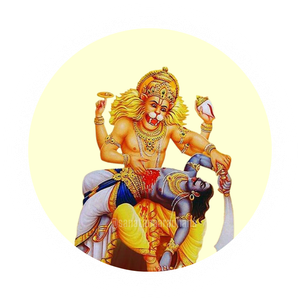
Jai Shri Hari! Narasimha Jayanti is a profoundly sacred occasion for all devotees, marking the divine appearance of Bhagwan Vishnu in His powerful Narsimha Avatar. This auspicious day reminds us of the Lord’s boundless love for His devotees and His unwavering commitment to upholding Dharma. Let us immerse ourselves in the glory of this special Vrat and its timeless Katha.
Narasimha Jayanti Vrat: A Special Observance
Date and Significance: Narasimha Jayanti is celebrated on the Chaturthi (fourth day) of the bright fortnight (Shukla Paksha) in the month of Vaishakha. On this sacred day, Bhagwan Vishnu incarnated as Narsimha to protect His beloved devotee Prahlada and to vanquish unrighteousness (Adharma). This Vrat is considered a supreme means to be shielded from fear, illness, enemies, and calamities.
The Sacred Katha of Narasimha Jayanti
As per the Hindu Panchang, the Vrat of Narasimha Jayanti is observed on the Chaturthi Tithi of the Shukla Paksha in the month of Vaishakha. As narrated in the Agni Purana and other sacred Puranas, it was on this most auspicious day that Bhagwan Vishnu assumed His Narsimha Avatar to protect His devotee Prahlada. This incarnation was so unique and wondrous that Bhagwan was neither fully human nor completely animal; He manifested in the form of half-lion and half-man. This is why this day is celebrated with immense reverence, faith, and joy as the Jayanti (birth anniversary) of Bhagwan Narsimha.
The sacred Katha narrates that in Satya Yuga, a demon king named Hiranyakashipu reigned. His brother, Hiranyaksha, had been slain by Bhagwan Vishnu Himself in His Varaha (Boar) Avatar. Burning with the fire of this insult and vengeance, Hiranyakashipu performed severe penance to Lord Brahma and obtained a boon that he could not be killed by any man or animal; neither during the day nor at night; neither indoors nor outdoors; neither by any weapon (astra) nor by any missile (shastra); nor on land, in water, or in the sky. Upon receiving this boon, he became invincible, and his arrogance swelled to its peak. He commanded the entire world to worship him and instituted severe punishments for anyone who dared to utter the name of Bhagwan Vishnu.
At that very time, his wife, Kayadhu, gave birth to a son, whom they named Prahlada. Despite being born into a demonic lineage, Prahlada’s heart was steeped in devotion to Shri Hari from birth. Every moment, he chanted the name ‘Shri Vishnu,’ sang bhajans, and spoke of the Lord’s glory. Witnessing Prahlada’s unwavering devotion, Hiranyakashipu’s rage reached its zenith. He tried every means to persuade, threaten, and frighten his son, but Prahlada remained steadfast.
Enraged, Hiranyakashipu made numerous attempts to end Prahlada’s life. He sent him to be crushed under the feet of elephants, tried to poison him, and cast him amidst venomous serpents. Once, with the help of his sister Holika, Prahlada was made to sit in a blazing fire. Holika possessed a boon that prevented her from being harmed by fire, but by the grace of Bhagwan, Prahlada remained unharmed, while Holika was consumed by the flames.
Finally, one day, Hiranyakashipu, seething with anger, demanded of Prahlada, “Where is this Vishnu whom you worship?” Prahlada calmly replied, “He is omnipresent; He is even in this pillar.” Hearing this, Hiranyakashipu furiously struck the pillar, and instantly, with a mighty roar, Bhagwan Narsimha manifested from within—in His form of half-lion and half-man. At twilight (neither day nor night), at the threshold of the palace (neither indoors nor outdoors), placing Hiranyakashipu on His lap (neither on land nor in the sky), and using His sharp claws (neither a weapon nor a missile), Bhagwan Narsimha slew the demon king.
Having protected His devotee, Bhagwan Narsimha blessed Prahlada and said, “My dear child, your name shall forever be remembered through the ages as a symbol of pure devotion (Bhakti Rasa).”
It is believed that any devotee who observes this Vrat with profound reverence and complete faith, performing Puja to Bhagwan Narsimha, becomes liberated from the sins of countless births, attaining Moksha and the supreme abode of the Lord. The spiritual merit (Punya) of Narasimha Jayanti Vrat grants protection from all forms of fear, illness, and calamity.
Method of Observing the Vrat
- On the day of the Vrat, rise during the Brahma Muhurta (early dawn), take a holy bath, and wear clean clothes.
- Take a Sankalp (vow) for the Vrat, stating, “Today, I shall observe a Nirjal (waterless) / Phalahar (fruit-based) Vrat to receive the grace of Bhagwan Narsimha.”
- Facing the East, install an idol or picture of Bhagwan Narsimha on a yellow cloth.
- Place a Kalash in front of the idol, adorned with a coconut and mango leaves.
- Perform Puja with Panchopachar (five offerings) or Shodashopachar (sixteen offerings)—offering Gandha (sandalwood paste), Akshat (rice grains), Pushpa (flowers), Dhup (incense), Deep (lamp), and Naivedya (food offering).
- Recite the Narasimha Kavach, Vishnu Sahasranama, or Narasimha Stotra.
- As special Naivedya, offer wheat halwa, Panchamrit, and soaked chickpeas.
- Observe a Vrat Jagran (night vigil), singing bhajans and Kirtan in praise of Shri Hari.
- On the following morning, break your Vrat (Paran) after offering charity (Dan) and Dakshina to Brahmins.
The Divine Narasimha Mantra
Ugram Veeram Maha Vishnum Jvalantam Sarvatomukham.
Nrisimham Bhishanam Bhadram Mrityur Mrityum Namamyaham ||
The Auspicious Fruits of the Vrat
As per the sacred scriptures, the devotee who observes this Vrat and performs Puja to Bhagwan Narsimha on this day becomes free from all sins, liberated from fear, illness, enemies, and calamities, and ultimately attains Vishnuloka (the abode of Bhagwan Vishnu).