


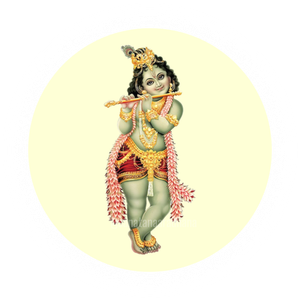
In Vaishnava traditions, Lord Shri Krishna is worshipped as the complete incarnation of Lord Vishnu or as the Supreme Lord Himself. He is revered as Jagadguru, the Divine Teacher who reveals the path of Dharma, protection of devotees, selfless action, divine love, Bhakti and spiritual knowledge. Devotees remember Him by many sacred names, including Vasudeva, Devakinandana, Govinda, Gopala, Damodara, Madhava, Murari and Giridhari.
Lord Shri Krishna is worshipped not only for the fulfilment of worldly wishes but also for inspiration to keep the mind absorbed in the Divine, perform one’s duties according to Dharma, reduce pride and live with love and compassion. His special worship is observed on Janmashtami, Ekadashi, Gita Jayanti and other Vaishnava festivals.
This page presents the simple name mantras, the twelve-syllabled Vasudeva Mantra, Gopala Mantra, Krishna Gayatri Mantra, Mahamantra, Pranama Mantra, Balakrishna Dhyana and brief Puja offering mantras dedicated to Lord Shri Krishna, along with their meanings. It is not necessary to chant all the mantras together. A devotee may select one principal mantra according to personal faith and spiritual tradition and chant it regularly.
Simple Method of Worshipping Lord Shri Krishna and Chanting His Mantras
- Take a bath in the morning or evening and wear clean clothes.
- Clean the place of worship and remember Lord Shri Ganesha, your revered Guru and your chosen deity.
- Light a lamp and incense before an image or sacred representation of Lord Shri Krishna or Radha-Krishna.
- Offer flowers, Tulsi leaves, fruits, Makhan-Mishri or other Sattvic Naivedya according to your faith and capacity.
- Select any one principal mantra from those given below.
- For ordinary daily worship, the mantra may be chanted 11, 21 or 108 times.
- A Tulsi or crystal Mala may be used for counting the repetitions.
- After completing the Jaap, pray to Lord Shri Krishna for Bhakti, righteous wisdom and inspiration to perform your duties according to Dharma.
Important: Take only as many Tulsi leaves as are genuinely required and avoid harming the plant. Along with Mantra Jaap, it is equally important to make one’s duties, conduct and actions more Sattvic.
Principal Mantras of Lord Shri Krishna
Simple Name Mantra of Lord Shri Krishna
This is a simple mantra dedicated to Lord Shri Krishna. It may be chanted during daily worship, meditation, Nama Jaap or before beginning an auspicious task.
Om Shri Krishnaya Namah॥
Meaning: I offer my respectful salutations to Lord Shri Krishna. May He inspire my mind towards the path of Bhakti and Dharma.
Simple Name Mantras of Lord Shri Krishna
Om Krishnaya Namah॥
Om Govindaya Namah॥
Om Gopalaya Namah॥
Om Damodaraya Namah॥
Om Devakinandanaya Namah॥
Om Vasudevaya Namah॥
Om Giridharine Namah॥
Om Muraraye Namah॥
Meaning: Through these sacred mantras, devotees remember and bow to Lord Shri Krishna in His divine forms as Krishna, Govinda, Gopala, Damodara, Devakinandana, Vasudeva, Giridhari and Murari.
Twelve-Syllabled Vasudeva Mantra of Lord Shri Krishna
This is the renowned twelve-syllabled mantra of Lord Vasudeva. It holds special significance in traditional Vaishnava worship.
Om Namo Bhagavate Vasudevaya॥
Meaning: I offer my salutations to the all-pervading Lord Vasudeva and seek refuge at His sacred feet.
This mantra is simple and suitable for daily Jaap. Devotees may chant it 11, 21 or 108 times according to their ability and devotion.
Shri Krishna Pranama Mantra from the Shrimad Bhagavatam
This renowned verse from the prayer offered by Mother Kunti in the Shrimad Bhagavatam bows to Lord Shri Krishna as the son of Vasudeva, the beloved son of Mother Devaki, the child of Nanda and Lord Govinda.
Krishnaya Vasudevaya Devakinandanaya Cha.
Nandagopakumaraya Govindaya Namo Namah॥
Meaning: Repeated salutations to Lord Shri Krishna, the son of Vasudeva, the source of joy for Mother Devaki, the beloved child of Nanda Baba and Lord Govinda.
Shri Krishna Gayatri Mantra
In this Gayatri Mantra, devotees meditate upon Lord Shri Krishna as Vasudeva and the son of Mother Devaki and pray that He inspires the intellect towards Dharma, knowledge and Bhakti.
Om Vasudevaya Vidmahe Devakisutaya Dhimahi.
Tannah Krishnah Prachodayat॥
Meaning: May we realise the divine form of Lord Vasudeva and meditate upon Lord Shri Krishna, the son of Mother Devaki. May Lord Shri Krishna inspire our intellect towards Dharma, divine love and auspicious actions.
Gopala Mantra of Lord Shri Krishna
This is the renowned eighteen-syllabled Gopala Mantra of Lord Shri Krishna. It remembers Him in His divine forms as Krishna, Govinda and Gopijanavallabha, the beloved Lord of the Gopis and His devotees.
Om Klim Krishnaya Govindaya Gopijanavallabhaya Svaha॥
Meaning: I offer my mind, faith and devotion to Lord Shri Krishna, who is worshipped as Govinda and is supremely dear to His devotees.
Important: This mantra contains a sacred Beej syllable. It may be chanted with ordinary devotional faith, but specialised Sadhana, Nyasa, Purashcharana or an extensive number of repetitions should be undertaken under the guidance of a qualified Vaishnava Guru or Acharya.
Hare Krishna Mahamantra
The Hare Krishna Mahamantra is widely recited for remembering and singing the sacred names of the Lord. The following sequence is especially prevalent in the Gaudiya Vaishnava tradition.
Hare Krishna Hare Krishna Krishna Krishna Hare Hare.
Hare Rama Hare Rama Rama Rama Hare Hare॥
Meaning: O Divine Energy of the Supreme Lord! O Lord Krishna and Lord Rama! Please engage me in Your loving Bhakti and selfless service.
This Mahamantra may be recited through personal Nama Jaap, devotional Kirtan or collective Sankirtana. In the available text of the Kali-Santarana Upanishad, the line containing the name of Rama appears before the line containing the name of Krishna. The sequence may differ among various Vaishnava traditions.
Prayer to Lord Shri Krishna for Relief from Distress
Krishnaya Vasudevaya Haraye Paramatmane.
Pranata Kleshanashaya Govindaya Namo Namah॥
Meaning: Salutations to Lord Krishna, Vasudeva, Hari and the Supreme Self. Repeated salutations to Lord Govinda, who compassionately relieves the distress of devotees who seek refuge in Him.
This prayer may be recited during difficult circumstances with the intention of calming the mind and seeking refuge, wisdom and appropriate guidance from the Divine Lord.
Renowned Vandana of Lord Shri Krishna
Vasudevasutam Devam Kamsachanuramardanam.
Devaki Paramanandam Krishnam Vande Jagadgurum॥
Meaning: I bow to Lord Shri Krishna, the son of Vasudeva, the destroyer of Kamsa and Chanura, the source of supreme joy for Mother Devaki and the Divine Teacher of the entire world.
Dhyana Mantra of Balakrishna
This renowned verse may be recited while meditating upon Lord Shri Krishna in His divine childhood form as Balagopala or Balamukunda.
Kararavindena Padaravindam Mukharavinde Viniveshayantam.
Vatasya Patrasya Pute Shayanam Balam Mukundam Manasa Smarami॥
Meaning: I meditate upon the child Lord Mukunda, who rests upon a banyan leaf while placing His lotus-like foot into His lotus-like mouth with His lotus-like hand.
Remembrance of the Sacred Names Govinda and Damodara
Shri Krishna Govinda Hare Murare He Natha Narayana Vasudeva.
Jihve Pibasvamritam Etadeva Govinda Damodara Madhaveti॥
Meaning: O tongue, continually drink the nectar of the sacred names Shri Krishna, Govinda, Hari, Murari, Narayana, Vasudeva, Damodara and Madhava.
Prayer for the Grace of Lord Madhava
Mukam Karoti Vachalam Pangum Langhayate Girim.
Yatkripa Tamaham Vande Paramananda Madhavam॥
Meaning: I bow to Lord Madhava, the embodiment of supreme bliss, whose divine grace is poetically praised as enabling the speechless to express themselves and the weak to overcome even mountain-like difficulties.
Verse of Surrender to Lord Shri Krishna from the Shrimad Bhagavad Gita
In the final chapter of the Shrimad Bhagavad Gita, Lord Shri Krishna instructs Arjuna to surrender pride, fear and attachment to the results of action and to seek refuge in the Supreme Lord.
Sarva Dharman Parityajya Mamekam Sharanam Vraja.
Aham Tva Sarva Papebhyo Mokshayishyami Ma Shuchah॥
Simple Meaning: Surrender the pride associated with your actions and attachment to their results, and seek refuge in Me alone. I shall liberate you from all sins and bondage; do not grieve.
This verse should not be understood as an instruction to abandon one’s worldly responsibilities. Its deeper meaning is to perform one’s duties while surrendering pride, fear and attachment to results at the sacred feet of the Lord.
Brief Offering Mantras for Lord Shri Krishna Puja
During a simple household Puja, the following mantras may be recited while presenting the different offerings. It is not necessary for every traditional item to be available. Lord Shri Krishna may also be worshipped with sincere faith using water, flowers, Tulsi leaves, a lamp and Sattvic Naivedya.
Om Shri Krishnaya Namah Avahayami Sthapayami॥
Om Shri Krishnaya Namah Asanam Samarpayami॥
Om Shri Krishnaya Namah Padyam Samarpayami॥
Om Shri Krishnaya Namah Arghyam Samarpayami॥
Om Shri Krishnaya Namah Achamaniyam Samarpayami॥
Om Shri Krishnaya Namah Snanam Samarpayami॥
Om Shri Krishnaya Namah Vastram Samarpayami॥
Om Shri Krishnaya Namah Yajnopavitam Samarpayami॥
Om Shri Krishnaya Namah Gandham Samarpayami॥
Om Shri Krishnaya Namah Akshatan Samarpayami॥
Om Shri Krishnaya Namah Pushpani Samarpayami॥
Om Shri Krishnaya Namah Tulasidalani Samarpayami॥
Om Shri Krishnaya Namah Dhupam Aghrapayami॥
Om Shri Krishnaya Namah Dipam Darshayami॥
Om Shri Krishnaya Namah Naivedyam Nivedayami॥
Om Shri Krishnaya Namah Phalam Samarpayami॥
Om Shri Krishnaya Namah Tambulam Samarpayami॥
Om Shri Krishnaya Namah Namaskaran Samarpayami॥
Meaning: O Lord Shri Krishna, I respectfully offer these articles of worship at Your sacred feet. Please accept them with compassion.
Puja Precaution: Only a suitable metal or stone Murti of Balagopala should be ceremonially bathed, according to the relevant tradition and material. Do not pour water, milk, ghee or honey over an image, or over a Murti made from clay, wood, plaster or painted material.
Brief Puja Method for Lord Shri Krishna
During the worship of Lord Shri Krishna, offerings such as Avahana, Asana, Arghya, ceremonial bathing, garments, Yajnopavita, sandalwood paste, incense, fruits and Tambula may be presented according to personal faith. It is not necessary for every item to be available. During a simple household Puja, Lord Shri Krishna may also be worshipped using water, flowers, Tulsi leaves, a lamp and Sattvic Naivedya.
Invocation Mantra of Lord Shri Krishna
At the beginning of the Puja, meditate upon Lord Shri Krishna and invoke His divine presence through this mantra.
Om Sahasrashirsha Purushah Sahasrakshah Sahasrapat.
Sa Bhumim Vishvato Vritva Atyatishthad Dashangulam॥
Agachchha Devadevesha Tejorashe Jagatpate.
Kriyamanam Maya Pujam Grihana Surasattama॥
Om Shri Krishnaya Namah Avahayami॥
Meaning: O Lord Shri Krishna, who pervades the entire universe, Lord of the Devas and sovereign of the world, please grace this sacred place with Your presence and accept the worship I offer with sincere devotion.
Mantra for Offering a Seat to Lord Shri Krishna
Rajadhiraja Rajendra Balakrishna Mahipate.
Ratnasimhasanam Tubhyam Dasyami Svikuru Prabho॥
Om Shri Krishnaya Namah Asanam Samarpayami॥
Meaning: O Balakrishna, King of kings and Supreme Lord of the entire world, I offer this divine throne for Your sacred seat. Please accept it graciously.
Mantra for Offering Arghya to Lord Shri Krishna
Paripurna Parananda Namo Krishnaya Vedhase.
Grihanarghyam Maya Dattam Krishna Vishno Janardana॥
Om Shri Krishnaya Namah Arghyam Samarpayami॥
Meaning: O Lord Shri Krishna, Vishnu and Janardana, who are complete and the embodiment of supreme bliss, please accept this Arghya that I offer with sincere faith.
Mantra for Offering a Honey Bath to Balagopala
According to the tradition of Panchamrita Snana, this mantra may be recited while ceremonially bathing a suitable metal or stone Murti of the Lord with honey.
Pushparenu Samudbhutam Susvadu Madhuram Madhu.
Tejah Pushtikaram Divyam Snanartham Pratigrihyatam॥
Om Shri Balakrishnaya Namah Madhusnanam Samarpayami॥
Meaning: This sweet and nourishing honey, produced from the pollen and nectar of flowers, is respectfully offered for Your ceremonial bath. Please accept it graciously.
Precaution: Do not pour honey or Panchamrita over an image, or over a Murti made from clay, wood, plaster or painted material. In such circumstances, mentally offer the sacred bath while reciting “Om Shri Balakrishnaya Namah, Madhusnanam Samarpayami”.
Mantra for Offering Garments to Lord Shri Krishna
Taptakanchana Sankasham Pitambaramidam Hare.
Sangrihana Jagannatha Balakrishna Namo’stu Te॥
Om Shri Balakrishnaya Namah Vastrayugmam Samarpayami॥
Meaning: O Lord Hari, Jagannatha and Balakrishna, this beautiful yellow garment, radiant like refined gold, is offered at Your sacred feet. Please accept it graciously.
Mantra for Offering the Yajnopavita to Lord Shri Krishna
Navabhistantubhir Yuktam Trigunam Devatamayam.
Yajnopavitam Maya Dattam Grihana Parameshvara॥
Om Shri Krishnaya Namah Yajnopavitam Samarpayami॥
Meaning: O Supreme Lord, I offer this sacred Yajnopavita, composed of nine strands and arranged in threefold form. Please accept it graciously.
Mantra for Offering Sandalwood Paste to Lord Shri Krishna
Shrikhanda Chandanam Divyam Gandhadhyam Sumanoharam.
Vilepanam Surashreshtha Chandanam Pratigrihyatam॥
Om Shri Krishnaya Namah Gandham Samarpayami॥
Meaning: O Lord Shri Krishna, Supreme among the Devas, please accept this divine, fragrant and pleasing sandalwood paste.
Mantra for Offering Incense to Lord Shri Krishna
Vanaspatirasodbhuto Gandhadhyo Gandha Uttamah.
Aghreyah Sarvadevanam Dhupo’yam Pratigrihyatam॥
Om Shri Krishnaya Namah Dhupam Aghrapayami॥
Meaning: I offer this excellent incense, prepared from the fragrant essence of sacred plants and considered suitable for offering to the Devas. Please accept it graciously.
Mantra for Offering a Coconut or Fruit to Lord Shri Krishna
Idam Phalam Maya Deva Sthapitam Puratastava.
Tena Me Safalavaptir Bhavej Janmani Janmani॥
Om Shri Krishnaya Namah Phalam Samarpayami॥
Meaning: O Lord, I respectfully offer this fruit before You. By Your grace, may my righteous actions and auspicious intentions become fruitful throughout my life.
Mantra for Offering Tambula to Lord Shri Krishna
Pugiphalam Mahadivyam Nagavalli Dalairyutam.
Eladi Churnasamyuktam Tambulam Pratigrihyatam॥
Om Shri Krishnaya Namah Tambulam Samarpayami॥
Meaning: I offer this Tambula prepared with betel nut, betel leaves and fragrant ingredients such as cardamom. Please accept it graciously.
Prayer for Forgiveness at the Conclusion of the Puja
Mantrahinam Kriyahinam Bhaktihinam Janardana.
Yat Pujitam Maya Deva Paripurnam Tadastu Me॥
Meaning: O Lord Janardana, please forgive any deficiency in mantra, ritual procedure or devotion within the worship I have offered. Kindly accept it and grant it spiritual completeness.
Which Shri Krishna Mantra Should Be Chanted?
- For simple daily Nama Jaap: Om Shri Krishnaya Namah॥
- For refuge in and devotion to Lord Vasudeva: Om Namo Bhagavate Vasudevaya॥
- For Sankirtana of the sacred names of the Lord: Hare Krishna Mahamantra.
- To inspire the intellect towards Dharma and Bhakti: Shri Krishna Gayatri Mantra.
- To bow to the various divine forms of Lord Shri Krishna: Krishnaya Vasudevaya Devakinandanaya Cha…
- For prayer during difficult circumstances: Krishnaya Vasudevaya Haraye Paramatmane…
- For meditation upon Balagopala: Kararavindena Padaravindam…
- For specialised Gopala Mantra Sadhana: Om Klim Krishnaya Govindaya Gopijanavallabhaya Svaha॥
It is not necessary to chant all the mantras together. For ordinary daily worship, a devotee may regularly chant any one of “Om Shri Krishnaya Namah”, “Om Namo Bhagavate Vasudevaya” or the Hare Krishna Mahamantra.
Traditional Significance of Shri Krishna Mantra Jaap
The worship of Lord Shri Krishna inspires divine love, Bhakti, spiritual knowledge, selfless action, Dharma and balance in life. In the Shrimad Bhagavad Gita, He teaches humanity to fulfil its duties while releasing attachment to results and seeking refuge in the Supreme Lord.
- To pray for deeper love and Bhakti towards the Divine Lord.
- To seek spiritual steadiness amid restlessness and discouragement.
- To fulfil one’s responsibilities with Dharma and honesty.
- To seek inspiration for reducing pride, anger, jealousy and excessive attachment.
- To cultivate loving and righteous conduct within the family and society.
- To maintain remembrance of the Lord during both happiness and sorrow.
The purpose of Mantra Jaap is not limited to obtaining worldly benefits. Its deeper purpose is to absorb the mind in the sacred name of the Lord and make one’s thoughts, conduct and actions more Sattvic.
Essential Precautions While Chanting Shri Krishna Mantras
- Pronounce the mantra as clearly as possible and chant it at a calm pace.
- Instead of changing the mantra every day, select one principal mantra and chant it regularly.
- Do not use Mantra Jaap as a means of attracting, controlling or influencing another person.
- Respect the relevant spiritual tradition and the guidance of a Guru when practising Beej Mantras or specialised Gopala Mantra Sadhana.
- Do not claim that these mantras guarantee a particular worldly result or miracle.
- Do not rely solely upon Mantra Jaap for family, health, financial or legal difficulties. Seek appropriate professional assistance whenever necessary.
- Along with devotion to Lord Shri Krishna, cultivate truthfulness, compassion, dedication to duty and Sattvic conduct.